Woven Patches vs Embroidered: Which is Right for Your Project?
Compare woven vs embroidered patches: detail capability, durability, cost & best uses. Learn which patch type suits your project needs with our comprehensive comparison guide that breaks down the strengths and weaknesses of each style.
Understanding Both Patch Types
Choosing between woven patches and embroidered patches is one of the most common decisions when ordering custom patches. Both styles have distinct characteristics, strengths, and ideal applications that make them better suited for certain projects. Understanding the fundamental differences between these two patch types is the first step in making an informed decision for your specific needs.
Woven patches and embroidered patches represent two fundamentally different approaches to creating custom fabric emblems. While both serve similar purposes - identification, branding, decoration - their manufacturing processes, visual characteristics, and performance characteristics are quite different. The choice between them often comes down to balancing factors like detail requirements, budget, durability needs, and aesthetic preferences. Weaving is one of humanity's oldest textile technologies, with evidence dating back thousands of years across cultures worldwide (Wikipedia, 2026).

What Are Embroidered Patches?
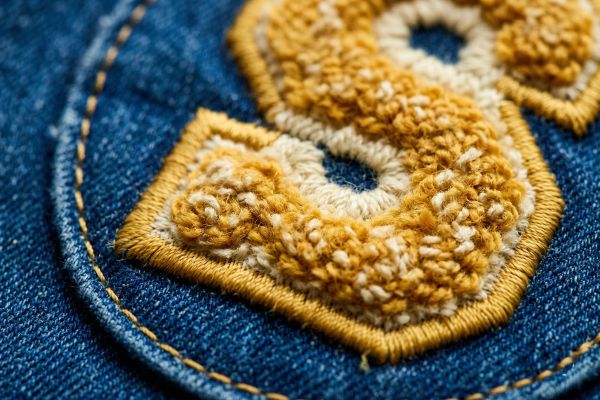
Embroidered patches are created by stitching thread directly onto a fabric backing, typically a sturdy twill material. This is the most traditional and well-known patch style, recognizable by its raised texture and classic appearance. The stitching process uses specialized embroidery machines that create designs through thousands of individual stitches, building up color and texture layer by layer.
Key Characteristics of Embroidered Patches
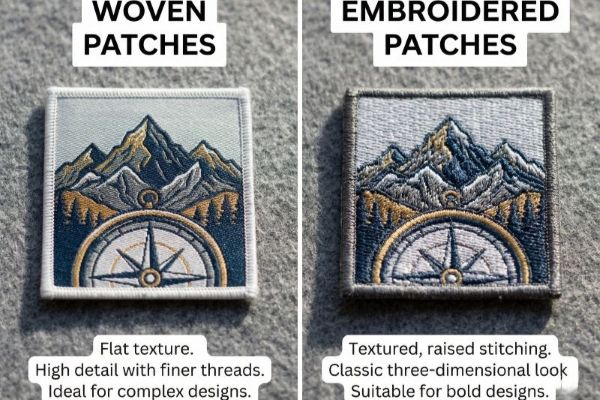
- Raised Texture: The thread stitching creates a tactile, three-dimensional surface that stands out from the backing fabric
- Classic Appearance: Timeless, traditional look that has been used for military, uniforms, and organizations for centuries
- Visible Stitches: Individual stitches are apparent, especially in larger areas of solid color
- Coverage Options: Available in 50%, 75%, or 100% embroidery coverage, affecting both appearance and cost
- Border Styles: Typically finished with either merrowed (overlock) borders or heat-cut borders
What Are Woven Patches?
Woven patches are created on specialized looms that weave the design directly into the fabric itself, rather than stitching on top of a backing material. The process is similar to how woven clothing labels are made, using thin threads in multiple colors to create incredibly detailed, flat designs. Woven patches have a smooth, flat texture with a fine-grained appearance that allows for exceptional detail reproduction.
Key Characteristics of Woven Patches
- Flat, Smooth Texture: The design is woven into the fabric, creating an even, flat surface without raised elements
- Exceptional Detail: Can reproduce extremely fine details, small text, and intricate designs that would be impossible with embroidery
- Photographic Quality: Can reproduce complex graphics, gradients, and even photographic-like imagery with remarkable clarity
- Thin and Flexible: Typically thinner and more flexible than embroidered patches, making them ideal for applications where bulk is a concern
- Clean, Precise Edges: The weaving process creates naturally clean edges without the need for additional border stitching
Side-by-Side Comparison
To help you make an informed decision, here's a comprehensive comparison of the key factors when choosing between woven and embroidered patches:
| Factor | Embroidered Patches | Woven Patches |
|---|---|---|
| Detail Capability | Good for bold designs, limited with small text and fine details | Excellent - can reproduce extremely fine details and small text clearly |
| Texture | Raised, tactile, three-dimensional feel | Flat, smooth, even surface |
| Cost | Generally less expensive for simple designs | Can be more cost-effective for complex, detailed designs |
| Durability | Very durable, excellent for heavy wear applications | Durable, but raised embroidery handles abrasion slightly better |
| Color Gradients | Limited - stitch-based color blending is challenging | Excellent - can create smooth gradients and photographic effects |
| Small Text | 4mm (5/32") minimum recommended size | 2mm (5/64") text can be clearly reproduced |
| Traditional Appearance | Excellent - classic, timeless look | More modern, graphic appearance |
| Thickness | Thicker due to raised stitching | Thinner and more flexible |
When to Choose Embroidered Patches
Embroidered patches are the better choice in the following situations:
Applications Where Embroidered Shines
- Military and Uniforms: The traditional look is preferred for military units, police, fire departments, and security organizations
- Bold, Simple Designs: Logos, shapes, and designs without extremely fine details look beautiful in embroidery
- Heavy Wear Applications: Work uniforms, outdoor gear, and items that will see heavy abrasion benefit from embroidery's durability
- Tactile, Premium Feel: The raised texture conveys quality and craftsmanship that many customers prefer
- Traditional Aesthetic: Schools, clubs, sports teams, and heritage brands often prefer the classic embroidered look
- Budget-Friendly Simple Designs: For straightforward designs without many colors or details, embroidery is typically more economical
Embroidered Patch Design Tips
- Keep text at least 4mm (5/32") tall for legibility
- Use bold, clean shapes rather than intricate details
- Limit color gradients and opt for solid color blocks
- Consider 75% coverage for a good balance of cost and appearance
- Merrowed borders give the most traditional appearance
When to Choose Woven Patches
Woven patches are the superior choice in these scenarios:
Applications Where Woven Excels
- High-Detail Logos: Complex brand marks with fine lines, small text, and intricate details reproduce beautifully
- Photographic or Gradient Designs: Can reproduce photographic imagery, color gradients, and complex graphics that embroidery cannot
- Product Labels and Branding: Perfect for clothing labels, product tags, and applications where a flat, precise appearance is desired
- Small Text Requirements: When text needs to be smaller than 4mm, woven is the only viable option
- Thin Profile Needed: Applications where patch thickness would be problematic, like inside garments or on delicate fabrics
- Modern, Graphic Aesthetic: Brands looking for a contemporary, clean, or graphic appearance often prefer woven patches
- Complex Color Schemes: Designs with many colors, blends, and transitions work better with woven construction
Woven Patch Design Tips
- Take advantage of the detail capability - include fine elements that embroidery can't reproduce
- Gradients and photographic elements work beautifully - don't be afraid to use them
- Text can be as small as 2mm (5/64") while remaining legible
- Complex logos with many fine lines are perfect candidates
- The flat profile makes them ideal for layering or applications where thickness matters
Still Not Sure Which Is Right for You?
Our expert team can help you decide between woven and embroidered patches based on your specific design, application, and budget. Get a free quote with digital proofs showing both options to help you make the best decision.
Get Free QuoteCost Comparison Considerations
Pricing between woven and embroidered patches depends on several factors related to your specific design:
Embroidered Patch Pricing Factors
- Coverage Percentage: 50% coverage is least expensive, 100% is most expensive
- Stitch Count: More stitches mean more time on the machine and higher cost
- Color Changes: Each color change adds production time, affecting cost
- Size: Larger patches require more materials and stitching time
- Border Type: Merrowed borders typically cost slightly more than heat-cut
Woven Patch Pricing Factors
- Complexity Matters Less: Detail level doesn't affect cost as dramatically as with embroidery
- Color Count: More colors can increase cost, but the impact is generally less than with embroidery
- Size: Larger patches require more material, increasing cost proportionally
- Economies of Scale: Woven patches often show better price breaks at higher quantities
- Setup Costs: Loom setup can have higher initial costs, offset by lower per-unit pricing at volume
General Pricing Guidelines
As a very general rule of thumb:
- Simple designs with few colors: Embroidery is usually less expensive
- Complex designs with many colors/details: Woven often becomes more cost-effective
- Small quantities (1-50): Embroidery typically has lower entry costs
- Large quantities (500+): Woven often offers better value due to economies of scale
Durability and Longevity Comparison
Both patch types offer excellent durability, but their performance characteristics differ slightly:
Embroidered Patch Durability
- Excellent Abrasion Resistance: The raised stitching stands up well to rubbing and wear
- Washing Performance: Withstands repeated laundering very well when properly attached
- UV Stability: Polyester embroidery thread maintains color well in sunlight
- Edge Durability: Merrowed borders prevent fraying exceptionally well
- Best for Heavy Wear: Uniforms, workwear, outdoor gear, and frequently washed items
Woven Patch Durability
- Good Abrasion Resistance: Durable, but the flat surface may show wear more visibly than raised stitching
- Excellent Washing Performance: Withstands laundering well, with less texture change than embroidery
- Color Fastness: Woven threads maintain color consistency and vibrancy extremely well
- Edge Integrity: Woven edges are naturally clean and resist fraying without additional finishing
- Best for Low/Medium Wear: Fashion apparel, product labels, bags, and general branding applications
Combination Approaches
For some applications, the best solution might involve combining both patch types strategically:
When to Consider Multiple Patch Types
- Product Lines: Use woven for detailed product labels and embroidered for branding elements
- Uniform Programs: Embroidered for main insignia, woven for name tags and detail elements
- Merchandise Assortment: Offer both options to customers with different aesthetic preferences
- Seasonal Collections: Use different patch types for different lines or seasons
Hybrid Patch Options
While true hybrid patches that combine both techniques in the same piece are rare, some creative approaches include:
- Layered Applications: Applying one patch type on top of another for interesting effects
- Complementary Placement: Using woven and embroidered patches in different locations on the same garment
- Material Combinations: Pairing patches with different textures for visual and tactile contrast
Frequently Asked Questions
Which patch type is more expensive?
It depends entirely on your specific design! For simple designs with few colors and basic shapes, embroidered patches are usually less expensive. For complex designs with fine details, small text, many colors, or photographic elements, woven patches often become the more cost-effective option. The quantity ordered also affects the equation - woven patches frequently show better price economics at higher volumes. The only way to know for sure is to request quotes for both options based on your specific design and quantity requirements.
Can woven patches have the same traditional look as embroidered?
Woven patches have a fundamentally different appearance than embroidered patches - they're flat and smooth rather than raised and textured. While they can certainly recreate traditional designs, they won't have the same tactile quality or classic stitched appearance. If the traditional, raised look is important to your project, embroidered patches are the better choice. However, woven patches have their own elegant, sophisticated appearance that many brands and customers actually prefer for its clean, precise, and contemporary aesthetic.
How small can text be with each patch type?
For embroidered patches, we recommend text be at least 4mm (5/32") tall for reliable legibility. Much smaller than that and stitches start blending together, making text difficult or impossible to read. Woven patches can reproduce text as small as 2mm (5/64") while maintaining excellent clarity. This makes woven patches ideal for applications where space is limited but legibility is crucial, such as clothing labels, small product tags, and compact branding elements. If your design includes text smaller than 4mm, woven is almost certainly the way to go.
Which patch type washes better?
Both patch types wash very well when properly attached, but there are slight differences in their performance characteristics. Embroidered patches with merrowed borders are extremely durable in laundry and resist fraying exceptionally well. The raised stitching also hides wear somewhat. Woven patches also wash very well - in fact, their flat texture shows less change through repeated washing than embroidery. Neither patch type is inherently "better" at washing - both are excellent choices for applications that will see regular laundering when properly attached (we generally recommend sewing for maximum durability in wash applications).
Can I see proofs of both options before deciding?
Absolutely! At ChinaPatchFactory, we're happy to provide digital proofs showing how your design would look as both an embroidered patch and a woven patch. This allows you to see exactly how your design reproduces with each method, compare the aesthetics side-by-side, and make an informed decision based on actual visualizations of your specific design. We can also provide pricing for both options simultaneously, so you have all the information you need to choose the best approach for your project, budget, and aesthetic preferences.
Conclusion
Choosing between woven patches and embroidered patches ultimately comes down to understanding your priorities and matching them to the strengths of each style. Neither is inherently "better" - they're simply different tools suited for different applications. Embroidered patches offer that classic, timeless look with a tactile, raised texture that has been beloved for centuries, while woven patches provide unparalleled detail reproduction, photographic clarity, and a clean, contemporary aesthetic.
The best decision balances your design requirements (detail level, text size, color complexity), your application needs (durability, washability, thickness constraints), your budget considerations, and your aesthetic preferences. Many organizations and brands even find that using both patch types for different elements of their program provides the best of both worlds - the traditional appeal of embroidery for main insignia, and the precision of woven for details and labels.
At ChinaPatchFactory, our experienced team has produced millions of both woven and embroidered patches for clients worldwide. We understand the nuances of each technique and can help guide you to the perfect choice for your specific project. Contact us today for free digital proofs showing your design in both styles, along with competitive pricing for both options, and discover which patch type will work best for bringing your vision to life.